

There are few animals more iconic to North America than the Whitetail Deer. Whether you’re a hunter, a photographer, or simply someone who spends time outdoors, chances are you’ve encountered one—often without even realizing it until the flick of a tail or the flash of movement gives them away.
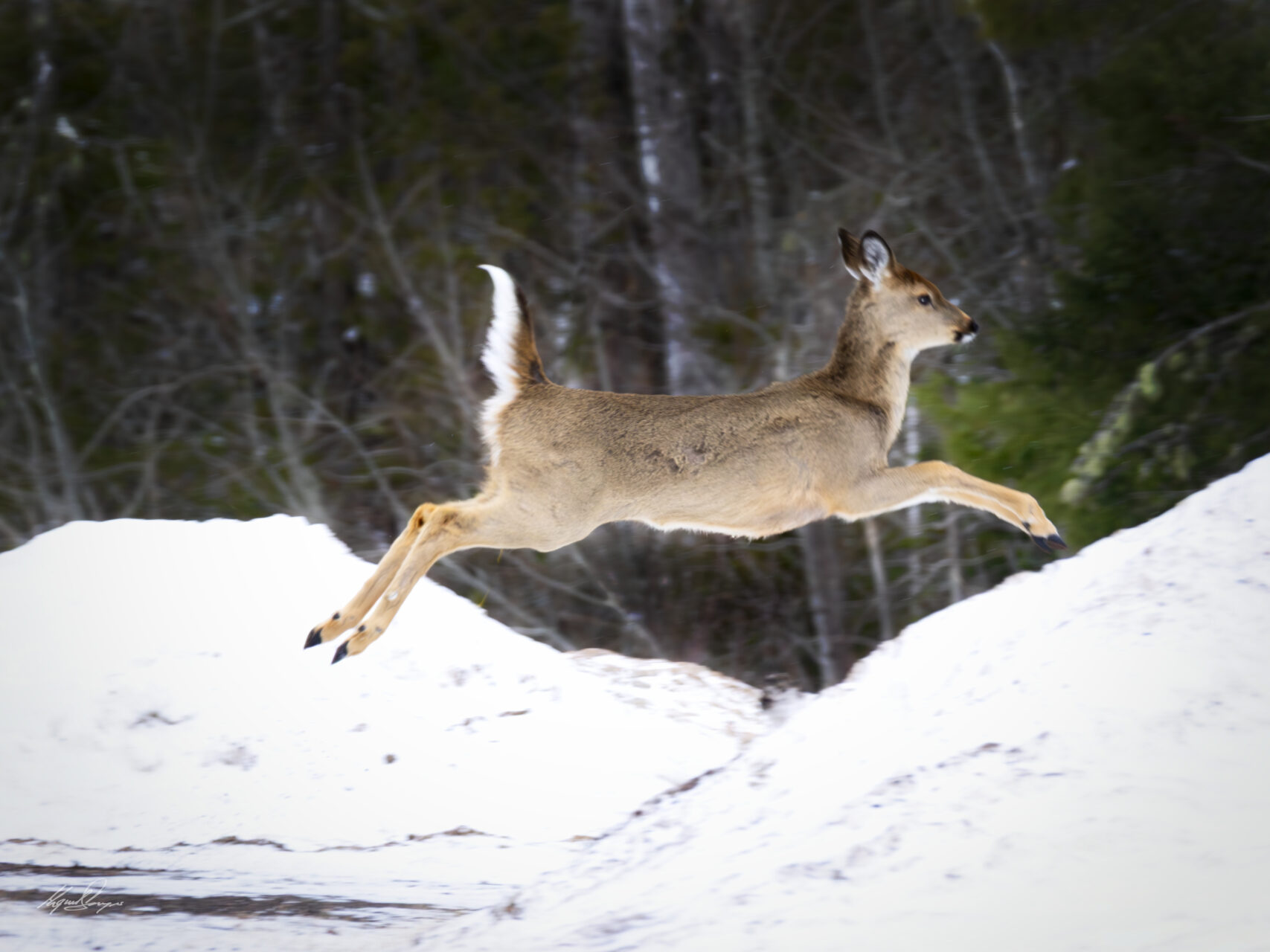
This particular image captures a whitetail in full flight… quite literally. A moment of explosive energy, frozen in time.
Overview
The Whitetail Deer (Odocoileus virginianus) is one of the most widely distributed large mammals in North America. Found from southern Canada through most of the United States and into Central America, it has adapted to an incredible range of habitats.
From dense forests and farmland edges to suburban neighborhoods, whitetails thrive wherever food, cover, and a bit of breathing room exist.
Identification
Whitetail Deer are medium-sized ungulates, typically recognized by:
- Reddish-brown coat in summer
- Grayish-brown coat in winter
- Distinct white underside of the tail
- Slender build with long legs
- Large, alert ears
The tail is the giveaway. When alarmed, it flashes upward like a signal flag—hence the name “whitetail.”
In this image, that raised tail is front and center… a clear sign this deer has already made the decision to leave.
Behavior and Movement
Whitetails are crepuscular by nature, meaning they are most active during dawn and dusk. That said, in pressured environments, they will shift their movement patterns to avoid human activity.
When startled, their response is immediate and decisive.
They don’t hesitate.
They launch.
What you’re seeing in this photograph is a classic bounding gait—often referred to as “stotting” or “pronking.” It’s not just about speed. It’s about unpredictability. Each bound can cover significant distance while keeping predators guessing.
And when they commit to escape, they can clear obstacles that would surprise most people.
Snowbanks included.
Habitat
Whitetails prefer areas that offer a mix of:
- Dense cover for bedding
- Open feeding areas
- Edge habitat where two environments meet
In winter, they often yard up in areas with reduced snow depth and increased shelter, conserving energy during harsher conditions.
Deep snow, like in this image, changes everything. Movement becomes more difficult, energy expenditure increases, and survival becomes a daily calculation.
Diet
Whitetails are browsers, not grazers.
Their diet consists of:
- Leaves and twigs
- Forbs (broad-leaf plants)
- Acorns and mast
- Agricultural crops when available
In winter, food becomes scarce, and they rely heavily on woody browse—often stripping buds and bark from shrubs and young trees.
The Photographer’s Perspective
Capturing a moment like this isn’t luck… it’s awareness.
You don’t get this shot by reacting.
You get it by anticipating.
Whitetails telegraph their intentions if you’re paying attention. A shift in posture. Ears locking onto a sound. Muscles tensing just before the explosion.
Miss those cues, and all you’ll photograph is an empty frame and a disappearing tail.
Nail it… and you get something like this.
A fraction of a second where instinct, motion, and survival all collide.
Final Thoughts
The Whitetail Deer is often overlooked because it’s familiar. Common, even.
But common doesn’t mean simple.
These animals are masters of survival. Adaptable. Alert. Always calculating risk versus reward.
And every now and then, if you’re ready for it, they’ll remind you exactly how fast the wild really moves.